6 things Bill Gates says AI will change before governments are ready
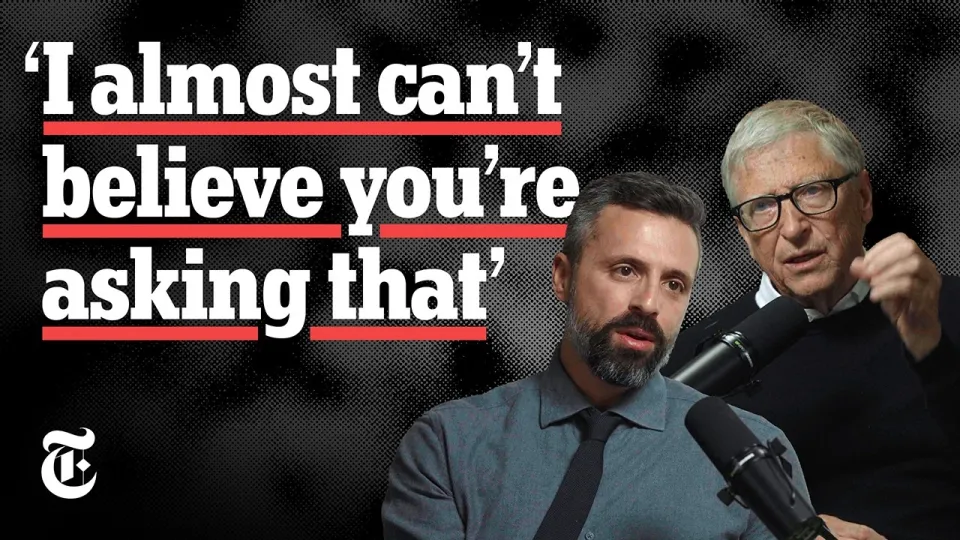
Video: Bill Gates: A.I. ‘Makes Nuclear Weapons Look Like Nothing’ | The Ezra Klein Show
Need articles like this for your video? They help promote it on YouTube and Google — order them in the Telegram bot @sat_sit_bot. It writes articles around your video, embeds the video and publishes them on popular niche websites (no ads). Free trial — 50 articles.
· based on the channel The Ezra Klein Show
Key takeaways
- Gates calls AI the most dangerous technology humanity has approached, saying it makes nuclear weapons look like nothing by comparison.
- He names catastrophic cyberattacks and bio-terrorism as the two thresholds where AI capability outruns existing safeguards.
- Industry self-regulation is, in his words, insane: lawsuits cannot answer an event that kills 100 million people.
- The Gates Foundation is set to spend down roughly $200 billion over two decades, with AI-driven inequality as a new priority.
- He argues the US–China race makes safety coordination harder, since neither side wants to slow down first.
Bill Gates believes artificial intelligence is the most dangerous technology humans have ever approached, and that the danger is larger than most people in authority admit. In a conversation with Ezra Klein, he argues that AI makes nuclear weapons look like nothing, and that only government action, not industry self-regulation, can blunt the coming damage. The full discussion is available in the New York Times Opinion transcript of the Ezra Klein podcast.
Gates is not a newcomer to the subject. The Microsoft co-founder and Gates Foundation chair spent years as an AI optimist, publicly arguing that the technology's benefits in health and education would outweigh its risks. What changed in this conversation is the tone: he describes himself as more worried than the alarmists, not less, and he is visibly impatient with people who treat the risks as hypothetical.
1. Gates now ranks AI above nuclear weapons on the risk scale
Gates' central claim is a comparison, and he does not soften it: AI is the most dangerous thing humanity has ever gone near. Nuclear weapons, in his framing, are a bounded problem, with a known number of warheads, known states that hold them, and decades of arms-control machinery behind them. AI is different because capability is diffuse, improving quickly, and available to actors who answer to no treaty.
He also draws a line between narrow, useful systems and the frontier systems that worry him. The concern is not that a chatbot writes a bad essay; it is that the same underlying capability that helps design a drug also helps design a pathogen, and the same model that hardens a network also finds its holes.
2. Two thresholds matter most: cyber and bio
Of all the failure modes discussed, Gates keeps returning to two: catastrophic cyberattacks and bio-terrorism. Both share a structure that makes them hard to govern. The knowledge required is increasingly cheap and widely distributed, the damage can arrive faster than any institution can respond, and the attacker needs only one success.
Cyber risk is the nearer-term problem, because the capability is already in circulation and the targets are civilian: power grids, hospitals, payment systems, water treatment. Bio risk is the one he treats as existential, because a single event could kill on a scale no legal system is built to process. That asymmetry, one actor versus millions of potential victims, is what makes voluntary codes feel inadequate to him.
3. Self-regulation, in his words, is insane
Gates is emphatic that the idea of the AI industry policing itself is not a serious position. His argument is structural rather than moral: companies compete, shareholders reward speed, and the firm that pauses to be careful loses ground to the firm that does not. Asking them to restrain themselves is asking them to act against their own incentives at exactly the moment those incentives are strongest.
He extends the same logic to liability. If a model-enabled event kills enormous numbers of people, the answer cannot be a lawsuit filed afterward. Litigation allocates money; it does not restore a grid, contain an outbreak, or deter an adversary who is not a company. The remedy has to be regulatory and it has to exist before the incident, which is precisely the sequence governments are worst at.
4. The China race makes coordination harder, not impossible
Gates treats the US–China competition as a real constraint rather than an excuse. Both governments worry that slowing down hands the other side an advantage, so each has a reason to keep the accelerator down. He nonetheless argues that some limits are shared interests, because a bio incident or a cascading cyberattack does not respect borders or alliances.
The practical version of this is unglamorous: thresholds that trigger mandatory reporting, testing regimes for frontier models, and controls on the specific capabilities that enable mass harm. Gates' point is that the race is a reason to move early and jointly on the narrow set of catastrophic risks, not a reason to wait for a global consensus on everything.
5. Jobs: not just losses, but a shift in what labor is worth
On employment, Gates is less apocalyptic than on security but still expects real disruption. Routine cognitive work, the kind that involves reading, summarizing, drafting and checking, is the most exposed, and it sits in the middle of many professional careers rather than at the bottom. Entry-level roles are where the damage shows up first, because that is where firms can most easily substitute a model for a junior person.
He sketches a few responses rather than one solution:
- Tax treatment of AI labor, so that automated work does not enjoy a structural advantage over employed people.
- A no-scarcity framing, in which productivity gains are treated as a public dividend rather than purely private profit.
- "Human reserved" categories, where society decides that certain roles, in care, education or judgment-heavy public service, should stay with people.
- Language and access tools, so that communities outside English-speaking markets are not left a generation behind.
He is careful about developing economies, where the same technology could leapfrog missing infrastructure or could wipe out the low-cost service work those economies depend on. Which outcome arrives depends on policy, not on the models.
6. Education, children and the political timetable
Gates' foundation work leads him to education, where he sees both the promise of tutoring that adapts to a single student and the risk of learning loss in rich countries that already show it. He argues that AI in classrooms needs the same regulatory attention as AI in medicine: rules for children's data, limits on what systems may do with a minor's information, and clear responsibility when a tool fails.
Politically, he expects AI to become a campaign issue before legislatures catch up, because voters encounter the consequences, in scams, in hiring, in schools, long before committees write rules. His foundation's spending plans reflect that: roughly $200 billion to be spent down over two decades, with making AI a force for equality rather than inequality named as a new priority.
The questions viewers keep asking
The reaction to the interview clustered around a few themes. One is credibility: if a technologist this central to the industry is frightened, what does that say about the people who are not? Another is fatalism, the sense that regulation always arrives after the damage and that an event killing enormous numbers of people cannot be answered by courts. A third is about the messenger, given Gates' own record and the scrutiny he has faced.
There is also a fair question about whether his warnings are self-serving, since the foundation and its partners stand to gain from being seen as the responsible stewards of the technology. Gates' answer, in effect, is that the incentives of the firms building frontier models point the other way, which is why he wants the rules written outside them. Viewers also noticed how he pushed back on the framing of questions rather than accepting the premise, and how rarely he interrupted to do it.
Useful links
- Full transcript of the Bill Gates conversation on The Ezra Klein Show
- Book recommendations from guests of The Ezra Klein Show
Bottom line
Gates' position is narrower and harder than either optimism or doom: the catastrophic risks are specific, the tools to reduce them are known, and the institutions that should act are behind. He wants mandatory testing and reporting at defined capability thresholds, liability that reaches beyond the courtroom, and a deliberate plan for what happens to work. The Ezra Klein Show, which produced this interview, is a useful place to follow the argument as it develops, because the questions asked there are the ones regulators will eventually have to answer. Start with the full transcript and decide for yourself whether the alarm is proportionate.
Source: Bill Gates: A.I. ‘Makes Nuclear Weapons Look Like Nothing’ | The Ezra Klein Show · Markdown version
Questions & answers
Why does Bill Gates say AI makes nuclear weapons look like nothing?
He argues that nuclear risk is bounded: a known number of warheads held by a known set of states, with decades of arms control behind it. AI capability is diffuse, improves quickly and is available to actors outside any treaty, so the same model that helps design a drug can help design a pathogen or find a network's weak points.
What does Gates propose instead of industry self-regulation?
Government-set rules that exist before an incident: mandatory testing and reporting at defined capability thresholds, restrictions on the specific capabilities that enable mass harm, and liability that goes beyond after-the-fact lawsuits. He considers self-regulation unworkable because firms that slow down lose to firms that do not.
How does Gates expect AI to affect jobs?
He sees routine cognitive work, drafting, summarizing, checking, as most exposed, with entry-level roles hit first. His responses include tax treatment of AI labor, treating productivity gains as a public dividend, reserving some human roles in care and public service, and language access tools so non-English markets are not left behind.
Is Gates' warning credible given his own record and interests?
That is the fair criticism viewers raise, since his foundation stands to gain from being seen as a responsible steward of AI. His answer is structural: the incentives of companies building frontier models point toward speed, which is exactly why the rules should be written outside them rather than by them.