AI Weekly Recap, GrokBot, ChatGPT and Claude Shake Up
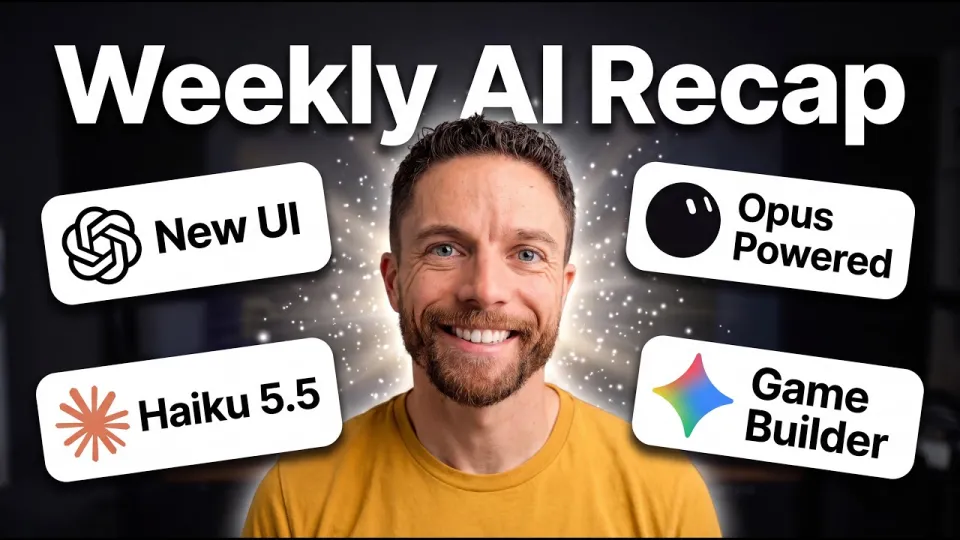
Video: Weekly AI Recap: GrokBot Just Did the Unthinkable, ChatGPT Looks Completely Different & More!
Need articles like this for your video? They help promote it on YouTube and Google — order them in the Telegram bot @sat_sit_bot. It writes articles around your video, embeds the video and publishes them on popular niche websites (no ads). Free trial — 50 articles.
· based on the channel Paul J Lipsky
Key takeaways
- GrokBot reportedly plans to route tasks to Claude, Midjourney and Suno, turning it into an orchestrator rather than a single-model assistant.
- ChatGPT gets an "Intelligent UI" that adapts the interface to the task instead of showing one fixed chat layout.
- Anthropic moves Claude Cowork to the cloud, so agent-style work continues without a local machine running it.
- Google adjusts Gemini plan tiers and ships Nano Banana 2.1, while Google Playground gets hands-on testing.
- The recap is Paul J Lipsky's weekly format, published on 9 October 2026.
AI news this week centers on one idea: assistants are becoming orchestrators. GrokBot is reportedly preparing to hand tasks to Claude, Midjourney and Suno, ChatGPT is getting an "Intelligent UI" that reshapes itself around the task, and Claude Cowork is moving to the cloud. The full rundown comes from Paul J Lipsky's weekly recap, and you can try the sponsor's agent platform via Okou.
What GrokBot's multi-model plan actually changes
The headline of the week is that GrokBot is moving from a single-model chatbot toward a router that picks the best tool for each job. According to the recap, the plan involves calling on Claude for some work, Midjourney for images and Suno for audio, rather than forcing every request through one model.
That matters for three practical reasons:
- Quality per task. Image generation, music and long-form reasoning have different strengths, and routing lets each request land on the system best suited to it.
- Fewer manual handoffs. A user describing a social video no longer has to copy a script into one tool, generate visuals in a second and audio in a third.
- New failure modes. Multi-model pipelines inherit the limits, pricing and content rules of every provider involved, so output quality can vary by step.
One viewer described handing GrokBot a folder of business videos plus instructions, receiving a voice script, recording it, and getting back a result better than paid work. That is exactly the workflow multi-model routing is designed to make routine — but it also shows why users want clear visibility into which model handled which step.
ChatGPT's Intelligent UI, explained
ChatGPT's interface is being rebuilt around the task rather than the message box. The "Intelligent UI" idea is that the product decides which surface to show — a canvas, a table, a set of controls, a document view — based on what you are trying to do, instead of presenting the same chat layout for everything.
For daily users the shift is less about new capabilities and more about discoverability. Features that used to hide behind menus can appear when they are relevant: a writing surface for drafting, structured output for comparisons, interactive elements for data. The trade-off is predictability — a changing interface means muscle memory breaks, and users who built workflows around a fixed layout will need to relearn where things live.
Claude Cowork moves to the cloud
Anthropic's Claude Cowork is shifting to a cloud model, which changes who can use agent-style work. Previously the appeal of a "coworker" assistant was tied to a machine running it; cloud execution means the work can continue while your laptop is closed and does not depend on local compute.
The practical consequences:
- Always-on tasks. Long jobs — research, drafting, file organization — can run in the background rather than during a session.
- Team access. Shared cloud workspaces fit team plans better than per-device installs.
- Data questions. Anything running in the cloud raises questions about where files live and who can see them, so permissions matter more, not less.
Anthropic also shipped a Haiku 5.5 update in the same cycle, continuing the pattern of a fast, cheap tier for high-volume tasks alongside the larger models.
Gemini plan changes and Nano Banana 2.1
Google's week was about packaging as much as models. Gemini's plan structure changed, and one viewer noted that a 2TB AI Plus tier now includes access to Google's Pro model — a detail worth checking against the current pricing page, since plan contents shift faster than most comparison articles.
On the model side, Nano Banana 2.1 is the image-generation update of the week, a refinement pass on Google's image tool rather than a new product. The recap also includes hands-on testing of Google Playground, the experimental surface where Google tries out interaction ideas before they reach mainstream products.
Common questions from people following this week's AI news
Readers following the weekly AI news cycle tend to ask the same handful of things, and the viewer comments around this recap are a good sample.
"Should I use one assistant or several?" Most people end up with one primary assistant plus specialist tools. Multi-model routing like GrokBot's plan reduces the number of tabs you manage, but specialists still win on niche tasks.
"Is the new ChatGPT interface better?" It is better for discovery and worse for muscle memory. Give it a week before deciding; most complaints about interface changes fade once the new locations become habit.
"Do I need to code to use Claude Code?" No, but the tool assumes comfort with a terminal and file paths. The most requested follow-up to this recap was a non-technical walkthrough, which suggests demand for exactly that on-ramp.
"Why did a bot appear in my workspace unannounced?" New assistant surfaces sometimes ship enabled by default. If something unfamiliar shows up, check the provider's release notes before deleting it — restoring a removed assistant is not always possible.
What this week signals about the AI market
The through-line is consolidation of the interface layer. Models are converging on similar capability tiers, so the differentiator is shifting to routing, surfaces and packaging: which tool gets called, how the UI adapts, and what your subscription includes. GrokBot's plan to borrow Claude, Midjourney and Suno is an admission that no single model wins everywhere; ChatGPT's Intelligent UI is an admission that the chat box alone is not enough; Claude Cowork's move to the cloud is an admission that agents need to run without you. Expect more plan reshuffling like Gemini's, and read the tier details before upgrading.
Final takeaway
The week's AI news points in one direction: the assistant you open is becoming a dispatcher, not a single brain. GrokBot's multi-model routing, ChatGPT's adaptive interface, Claude Cowork's cloud shift and Gemini's repackaged tiers all push users toward choosing a platform rather than a model. For anyone testing these workflows, Okou offers a way to try agent-style automation directly. Paul J Lipsky's weekly recap remains a useful benchmark for what actually shipped versus what was merely announced, and the comment section is a reliable signal of which features people adopt and which they quietly abandon.
Source: Weekly AI Recap: GrokBot Just Did the Unthinkable, ChatGPT Looks Completely Different & More! · Markdown version
Questions & answers
What is GrokBot's plan to use Claude, Midjourney and Suno?
According to the weekly recap, GrokBot is moving toward routing tasks to other models instead of handling everything itself — Claude for reasoning-heavy work, Midjourney for images and Suno for audio. The practical effect is fewer manual handoffs between tools, though each provider's limits and pricing still apply to the relevant step.
What is ChatGPT's Intelligent UI?
It is a redesign in which ChatGPT adapts its interface to the task rather than showing one fixed chat layout. Depending on what you are doing, it may surface a writing canvas, structured output or interactive controls. The benefit is discoverability; the cost is that familiar menu locations move.
What changes with Claude Cowork moving to the cloud?
Cloud execution means agent-style work can continue without your machine running it, and shared workspaces fit team plans better than per-device installs. It also makes permissions and data location more important, since files are processed off-device.
Did Gemini's plans change, and what is Nano Banana 2.1?
Gemini's plan tiers were adjusted, with viewers noting that a 2TB AI Plus tier now includes access to Google's Pro model — check the current pricing page, since inclusions shift often. Nano Banana 2.1 is the week's image-generation update, a refinement of Google's existing image tool rather than a new product.